The Soil Food Web: The Hidden Underground City Beneath Your Trees

Now we’re getting into the really fascinating part of tree biology — the hidden underground universe known as the Soil Food Web.
At first, the name sounds like something pulled from a graduate-level science textbook, but the idea is actually pretty simple:
Healthy soil is alive.
Very alive.
Beneath every healthy tree exists an entire underground ecosystem made up of roots, fungi, bacteria, insects, earthworms, protozoa, mites, water, oxygen, minerals, and countless microscopic organisms all interacting together in an incredibly complex living network.
And honestly, it’s one of the most important systems on Earth.
There’s More Life in Soil Than You Think
Before we go further, let’s clear something up: the Soil Food Web is not some trendy gardening buzzword.
This is well-established science supported by decades of research from scientists like Elaine Ingham and many others who helped reveal just how alive healthy soil really is.
Here’s the mind-blowing part:
A single teaspoon of healthy soil can contain billions of microorganisms.

Billions.
That means the ground beneath your feet may contain more living organisms than there are humans on the planet.
Suddenly dirt starts sounding a lot more interesting.
Soil Isn’t Dirt — It’s an Ecosystem
Most people think of soil as just “brown stuff plants grow in.” But healthy soil functions more like a living city.
Every organism has a job.
Bacteria help decompose organic matter and cycle nutrients.
Fungi form massive underground networks that transport water and minerals.
Protozoa and nematodes feed on bacteria and release nutrients plants can absorb.
Earthworms aerate the soil and mix organic matter.
Insects, mites, beetles, and millipedes shred leaves and wood into smaller pieces for microbes to process.

Nature wastes absolutely nothing.
Leaves fall. Branches decay. Organisms consume them. Nutrients get recycled back into the soil. New roots absorb those nutrients, and the cycle continues over and over again.
In a natural ecosystem, there is no such thing as “waste.”There is only recycling.
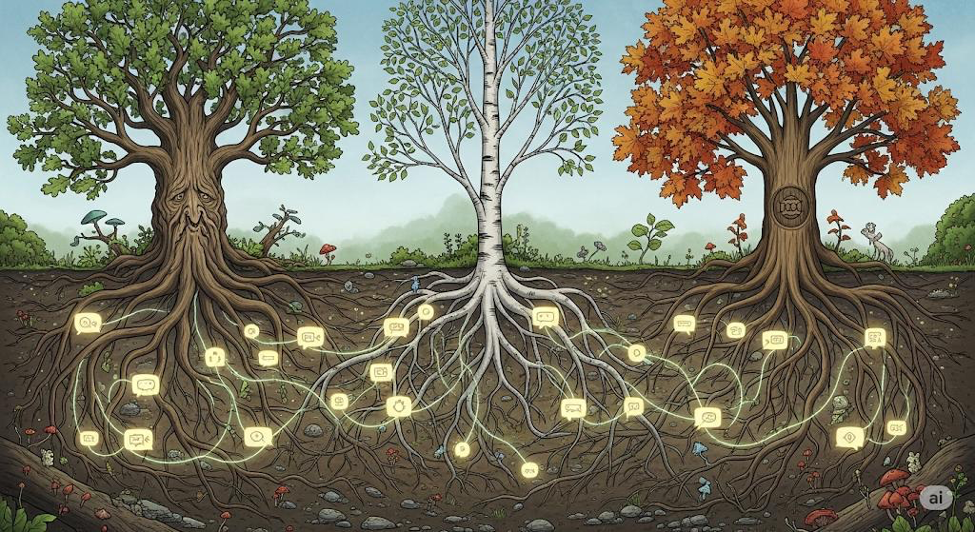
The Underground Internet of Trees

One of the most fascinating parts of the Soil Food Web is fungi — especially mycorrhizal fungi.
These fungi form partnerships with tree roots and create vast underground networks often called the “Wood Wide Web.”
Yes, trees basically have underground internet connections.
The fungi help roots absorb water and nutrients far more efficiently than roots could alone. In exchange, the tree shares sugars produced through photosynthesis.
It’s a perfect trade agreement: “Here’s some sugar. Please bring me phosphorus and water.”
Some studies even suggest trees may use these fungal networks to transfer nutrients and chemical signals to neighboring trees.

The forest is far more connected than it appears above ground.
Why Soil Structure Matters
As soil organisms move through the ground, they create tiny tunnels and air pockets in a process called bioturbation.
These microscopic spaces are incredibly important because they allow:
Oxygen to reach roots
Water to infiltrate properly
Nutrients to move through the soil
Roots to expand and grow

Without these spaces, soil becomes compacted, dense, and lifeless.
And compacted soil is one of the biggest hidden problems in urban landscapes.
A tree may look fine above ground while its roots are slowly suffocating below the surface.

That’s why construction damage, heavy equipment, excessive foot traffic, and poor drainage can create long-term tree health problems years before visible decline appears.
Healthy Soil = Healthier Trees

A thriving Soil Food Web helps trees in ways most people never see.
Healthy soil can:
Improve root growth
Increase drought tolerance
Reduce stress
Suppress harmful pathogens naturally
Improve nutrient availability
Increase resilience against insects and disease
In many cases, healthy soil reduces the need for excessive fertilizers and chemical treatments because the ecosystem begins functioning the way nature intended.
Healthy trees begin with healthy roots. Healthy roots begin with healthy soil.

Everything is connected.
Take a Closer Look at Your Soil
The next time you walk through your landscape, pause for a moment and really look at the soil around your trees.
Ask yourself:
Is the soil bare and exposed?
Does it smell earthy and alive or sour and stagnant?
Is organic matter present?
Are earthworms active?
Is the soil loose and breathable or hard as concrete?
And perhaps most importantly:
Are you mulching correctly?
Because mulch plays an enormous role in feeding and protecting the Soil Food Web — when it’s used properly.
Done correctly, mulch acts like the forest floor itself:
Conserving moisture
Moderating temperature
Reducing compaction
Feeding soil organisms
Slowly returning nutrients back into the ecosystem
Done incorrectly… well, volcano mulch is another conversation entirely.
But one thing is certain:
The real magic of trees doesn’t just happen above ground in the canopy.
It happens below your feet in an invisible living world that most people never even realize exists.
Comments